RIVER ARCHIVE / MINNOW LURE GUIDE
Slow-Floating vs. Suspending Minnow Lures: What the Specifications Mean
Start with what happens when you pause. Learn the difference between floating, slow-floating and suspending minnow lures, then read running depth and setup details separately. RIVAS specifications are clearly identified as owner-reported.
Start with the pause comparison
- Focus
- Pause behavior
- Compare
- Buoyancy and running depth
- Sources
- Manufacturer guidance
- RIVAS
- Owner-reported specifications
01 / START WITH THE PAUSE
What happens when you stop retrieving?
A minnow lure can dive during the retrieve and rise when you pause. Another can dive and then remain close to the same depth. That difference is buoyancy—not a ranking of quality, and not the same thing as diving depth.
- Floating
- Positive buoyancy: the lure tends to rise when it is no longer being pulled underwater. “Floating” alone does not tell you how quickly.
- Slow-floating
- Still positively buoyant, but intended to rise gradually. The label does not give a measured rise rate or guarantee the same behavior with every setup.
- Suspending
- Designed around near-neutral buoyancy, so the lure stays near its paused depth instead of deliberately rising or sinking. Check the actual lure in your water.
For manufacturer examples, Rapala identifies the Original Floating as floating and describes the Down Deep Husky Jerk as suspending on a pause through neutral buoyancy.
Read the full description, not just the category. Rapala’s RipStop description includes a very slow rise, while its specification field says suspending. Treat the label as a starting point; the described movement matters.
02 / TWO DIFFERENT SPECIFICATIONS
Buoyancy is not running depth.
Buoyancy describes the tendency to rise, hold or sink. Running depth describes where the lure travels while being worked. A floating lure is not necessarily a surface-only lure: Rapala lists both floating buoyancy and underwater running-depth ranges for the Original Floating.
A depth figure also needs context. The Down Deep Husky Jerk description gives different depth figures for casting and trolling. Do not read a maximum depth as a promise for every cast, line or retrieve.
03 / CHECK THE WHOLE SETUP
Small changes can change the result.
- Hooks and added hardware. Megabass explains that replacing trebles with larger or heavier hooks changes a jerkbait’s balance and performance. Do not assume a hook swap preserves its original pause behavior. Read the manufacturer’s hook guide.
- Line and leader. Megabass notes that leader diameter affects jerkbait action. Record your line material and diameter when comparing behavior; do not borrow another model’s recommended line size as a RIVAS specification. See the X-80 Jr line guidance.
- Water conditions. Megabass’s tuning guidance identifies water temperature and small additions such as a snap or weight as relevant to suspension. Check again when conditions or tackle change. Read the suspension-tuning discussion.
Our practical takeaway: from a safe, permitted position, observe your rigged lure in visible water before relying on its label. Note whether it rises, holds or sinks during a pause. Keep the setup consistent and change one thing at a time. This is a suggested observation routine, not a standardized test.
04 / APPLYING THIS TO RIVAS
RIVAS: the specification and the evidence.
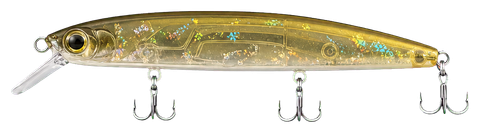
The current RIVAS specifications below are owner-reported. They are not measurements calculated from the underwater footage.
- Body length
- 95 mm
- Buoyancy
- Slow floating
- Weight
- 3/8 oz (approx. 10.6 g)
- Maximum diving depth
- Up to 1.2 m
The gram value is converted from 3/8 oz. Actual running depth varies with line and retrieve. Final production details will be confirmed before release.
A steady-retrieve clip shows movement during that retrieve. It does not establish a measured rise rate on a pause, verify the maximum depth or demonstrate catch performance. The footage is not a controlled comparison with a suspending lure.
RIVAS is not yet for sale. Release-update registration is not an order, payment or lure reservation.
RIVAS / VIEW THE EVIDENCE